
Contents
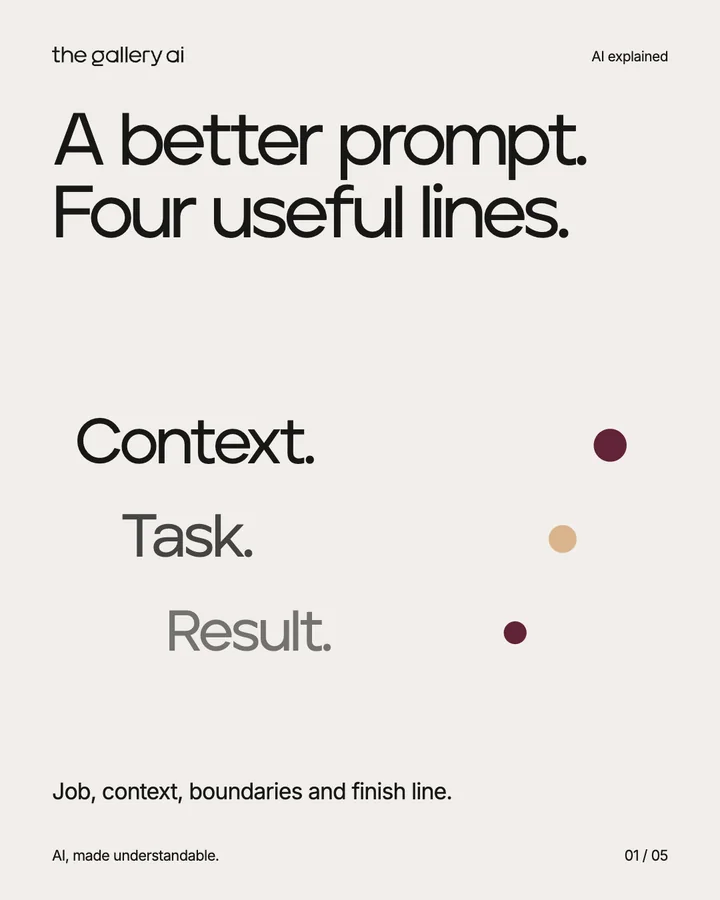
"Make this better" leaves a lot for the AI to decide. Better for whom? Better at doing what? How will either of you know when it's ready? I think it comes down to four plain things. You don't need a page of instructions to make them clear.
The four parts
The job. What to make, for whom. Name the reader and the decision the answer should help them make.
The context. What to use. The approved document, the notes, the quote, the thread. Not the AI's guess at any of them.
The boundaries. What must stay true. The facts that can't change, the things it mustn't promise, the gaps it should mark rather than fill.
The finish line. What should come back, in what shape. Length, format, tone, plus a separate list of anything still unconfirmed. This is the part people skip. It's also the one that makes the other three worth writing, because now you can check each of them.
As a template: Make [output] for [reader]. Use [source]. Keep [boundaries]. Return [format].
A worked example
Say a plumber has quoted to replace a leaking kitchen mixer tap in a two-bedroom unit and the owner needs to approve it. Here's the brief.
"Write an email to the owner about the attached quote to replace the kitchen mixer tap. Use the attached quote and the job notes from the property manager. Keep the quoted price and start date exactly as written, don't suggest a cheaper tap we haven't priced and don't promise a completion date. Return a subject line, an email under 150 words in our usual tone and a separate list of anything that needs confirming before it goes."
Now the answer is checkable. Did it keep the price? Did it invent a finish date? Does the list of open questions include the one you'd have asked, about access to the unit? Each line of the brief is a check you can run. Then compare the draft with the quote. Did the meaning change? Did a promise appear that wasn't in the source?
A free tool for the moment before you press send
At The Gallery AI we built a small Brief Builder for exactly this step. It asks for the goal, the reader, the context and what should come back, then writes the brief for you to take to Claude or ChatGPT. It doesn't run AI and it doesn't check your facts. What you type stays in the page. Try it on one task you understand well enough to judge the result.
What a person still does
A clear brief helps you inspect the answer. It doesn't guarantee the answer is right. A person still compares the draft with the quote, reads it as the owner would and decides whether it goes.
My weekly email, This week in AI, covers what happened and what it means for a business like yours, with one thing to try each time. Sign up here.