
Contents
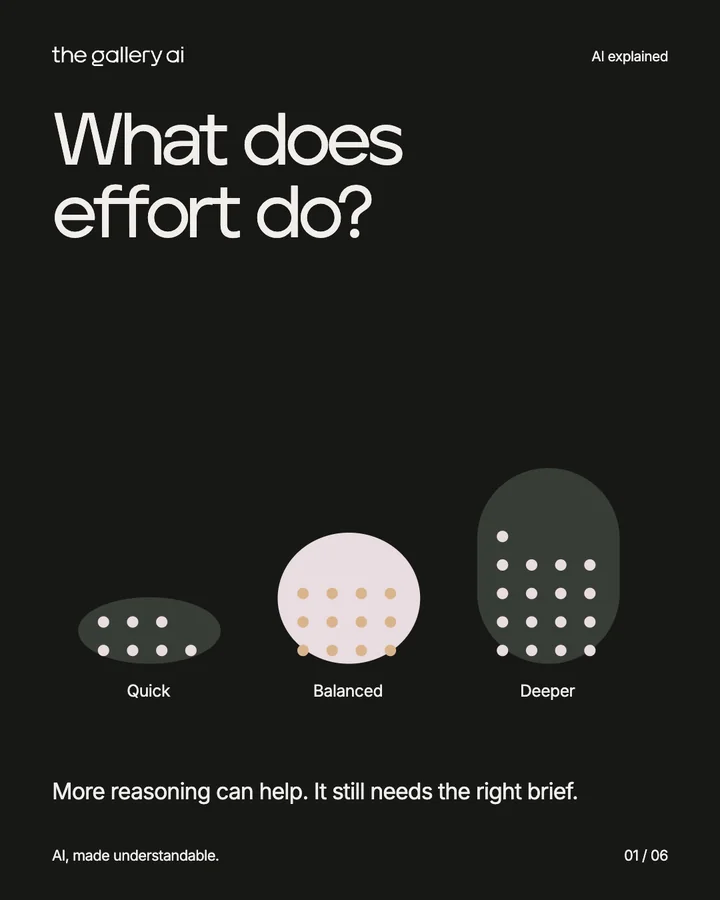
Claude and ChatGPT both let you choose how hard the model works on an answer. The control goes by different names depending on the product: effort here, thinking there, sometimes a switch, sometimes a menu of low, medium and high. People ask me which one to use. My honest answer is that the question doesn't mean anything until you attach it to a job.
What the setting changes
More effort means the model spends longer on the problem before it answers. It considers more possibilities, checks more of its own steps and takes more time doing it. That costs you something. On a subscription it's the wait. If you're paying by use it's the bill.
It doesn't go and find facts you didn't give it. A wrong brief on high effort is a wrong brief that took longer.
Low: a bounded edit
Low is for work with little to untangle. Shorten this approved paragraph. Soften the tone of this reply. Put these notes into a table. The source is in front of it and the finish line is obvious. Turning the effort up here just makes you wait longer for the same answer.
Medium: a few moving parts
Medium is my everyday setting for anything with a handful of decisions inside it. Comparing two options against the same goal, or a first draft with a few considerations to balance.
Say an owner has two quotes to replace a hot water system. One's cheaper, one carries a longer warranty and the tenant has been without hot water since Tuesday. Medium is enough to set out the useful differences and the questions still open: when each plumber can start, whether the cheaper unit suits the building. The owner gets a decision to make rather than two PDFs to decode.
High: when decisions depend on each other
High is for work where several decisions pull on each other. It's also for anything where being wrong costs real money or trust. Planning a leasing campaign around a vacate date, a repaint and an owner who's overseas for a fortnight. Anything where a missed detail would embarrass you.
Ask it to list its assumptions and the conflicts it found. That's where the extra thinking earns its keep. Some tools offer a level above high. Keep that for the genuinely hard end of this category, not as a default.
What a person still does
The honest test is to give two settings the same brief and compare what comes back. If high didn't improve on medium, you've learned something useful about that job.
Higher effort doesn't guarantee accuracy. A slow answer can be just as wrong as a quick one. It's usually more convincing, which is the problem. The setting decides how hard the model works. It doesn't change who's responsible for the result. A person still reads it, checks it against the source and decides whether it goes.
To see the difference on an invented example from your own work, book a free call.