
Contents
Most of what makes a business good lives in people's heads, in old emails and in the way the team does things. AI can't read any of that. So when someone tells me the AI doesn't get their business, my first question is where the business is written down. The usual answer is nowhere, or in six places that disagree.
The 20-minute document
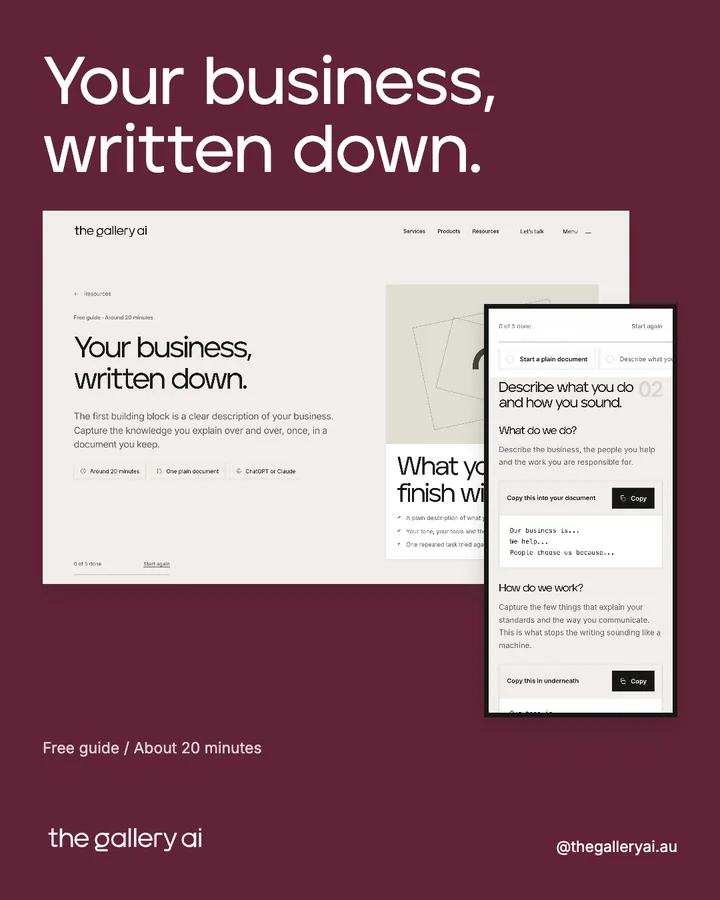
Open a plain document. Call it "Our business, written down". Write it the way you'd explain the business to someone starting on Monday, under four headings.
What we do. Who you help and what you actually do for them, in two or three sentences.
Who does what. The team, what each person owns and which questions go to whom.
How we sound. The tone, the words you use, the words you avoid. One example of an email you were happy with.
What stays with a person. Money, legal notices and bad news usually belong here. Writing this down is the difference between a draft you check in ten seconds and one you read twice.
Twenty minutes. Don't polish it. A rough document the AI can read beats a perfect one that's still in your head.
The first twelve things
That document grows. I keep a list of twelve things I think every business should write down. The first four do most of the work: how you sound, what you charge, who owns which part of the work and how the repeated jobs get done. Get those four onto paper and the AI stops guessing at the things that matter most.
Here's what it looks like in practice. Say a small agency writes down how a repair request is handled: who logs it, which trades get used, when the owner has to approve a cost and what the tenant is told along the way. Paste that into Claude or ChatGPT with a tenant's message about a dripping tap and ask for the reply. Then compare it with what you'd actually send. Whatever's wrong is usually missing context rather than a missing feature. Add the context and ask again.
Keep it as the one source
The document only works if it's the one maintained source. Not three versions in three inboxes. When a fee changes, when someone's role changes, when a procedure changes, the document changes first. Everything the AI drafts comes from it, so everything the AI drafts can be checked against it.
That's how my agency runs. I've written up the whole picture in Running an agency on AI, which is the lived version of this article.
What a person still does
Writes it, because nobody else can. Decides what stays with a person. Keeps it current when the business moves. The AI works from the document. A person owns the document.
If you'd rather do the writing down with someone who's done it in their own business, AI Foundations is a practical place to start.